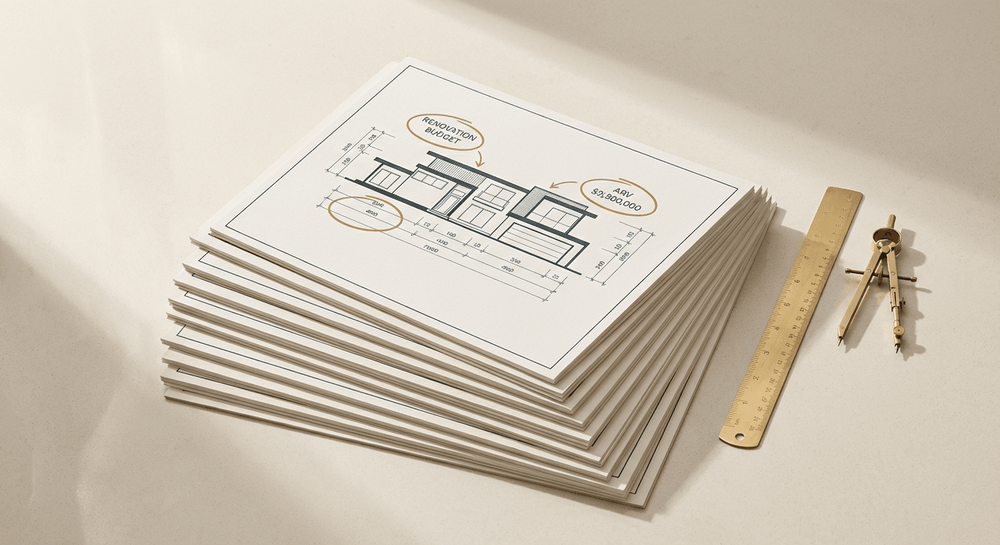
Most construction financing content in Canada is written for developers building subdivisions and commercial projects from the ground up. That content does not address what real estate investors actually need: capital for renovation-intensive acquisitions, residential densification projects, and small multi-unit conversions — deals where the construction component is the value-creation mechanism, not the end product.
Private construction financing for investors operates differently from traditional development financing. The loan amounts are smaller. The timelines are shorter. The exit strategy is a refinance into conventional financing, not a sale to end buyers. And the draw structures must account for the realities of renovation work — which rarely follows the linear progression that institutional construction lenders expect.
At Private Mortgages Canada, we have structured construction financing for investor projects across Ontario — from BRRRR renovations in Hamilton to laneway home builds in Toronto to duplex-to-fourplex conversions in Kitchener-Waterloo — as part of 6,500+ deals and more than $2 billion in capital deployed across the Streetwise platform over 20+ years. This guide covers how private construction draws work for investors, what to expect at each stage of the process, and how to structure the financing so the project moves forward without stalling.
How Does Construction Financing for Investors Differ from Developer Financing?
Traditional construction financing is designed for licensed developers building new homes or commercial properties for sale. The lending model assumes a large-scale project with architectural drawings, engineering reports, a general contractor with bonding, and a pre-sale component. The exit is the sale of completed units.
Investor construction financing operates on a different model entirely.
Project scale. Investor projects typically range from $50,000 to $500,000 in construction costs, compared to millions for development projects. These are renovations, additions, and conversions — not ground-up commercial builds.
Exit strategy. The investor's exit is a refinance into conventional or B-lender financing based on the property's after-renovation value (ARV), not a sale. This means the private construction financing must be structured around the refinance timeline, not a sales cycle.
Contractor structure. Investors often manage their own renovations using trade-specific subtrades rather than hiring a single general contractor. This requires a draw structure flexible enough to accommodate multiple contractors working on different components of the project.
Permit and inspection requirements. Investor projects in Ontario still require building permits under the Ontario Building Code for structural work, electrical, plumbing, and HVAC modifications. But the permit scope is typically narrower than a full development project, and the inspection schedule is aligned with the renovation scope rather than a multi-phase new build.
The three most common investor construction scenarios in Ontario:
01. BRRRR renovation projects. Purchase a below-market-value property, renovate to increase both appraised value and rental income, then refinance into conventional financing. The construction component is typically a full interior renovation: kitchen, bathrooms, flooring, mechanical systems, and sometimes structural modifications. Budget range: $60,000 to $200,000. For a detailed walkthrough of how private capital fits into each phase of the BRRRR strategy, see our dedicated guide.
02. Residential densification projects. Build an accessory dwelling unit (ADU), garden suite, or laneway home on an existing property to add rental income and increase the property's overall value. Ontario's housing policy changes have expanded zoning permissions for ADUs across many municipalities, creating new densification opportunities for investors. Budget range: $150,000 to $400,000.
03. Small multi-unit conversions. Convert a single-family home into a duplex, triplex, or fourplex — or add units to an existing multi-unit property. These projects require building permits, fire separation upgrades, and compliance with the Ontario Building Code for multi-unit residential occupancy. Budget range: $100,000 to $350,000.
All three scenarios share a common financing challenge: traditional banks do not fund renovation-intensive projects well. The property's current condition often fails bank appraisal standards, the construction timeline requires capital that banks are not structured to advance in stages, and the investor's portfolio may already exceed the bank's property count limits. Private construction financing fills that gap.
How Do Private Construction Draws Work for Investor Projects?
A construction draw is a staged disbursement of the renovation or construction budget. Instead of advancing the full budget at closing, the lender holds back the construction funds and releases them in tranches as work is completed and verified through inspection.
This structure serves both parties. The lender only advances capital against completed work, reducing the risk of funding a project that stalls mid-renovation. The investor receives capital in predictable stages, providing a structured framework for managing contractor payments and project cash flow.
The Draw Schedule Structure
A typical private construction draw schedule for an investor renovation project in Ontario follows this framework:
| Draw | Stage | Typical % of Budget | Release Trigger |
|---|---|---|---|
| Draw 1 | Demolition, structural modifications, foundation work | 20-30% | Building permit confirmed, demolition and structural work complete |
| Draw 2 | Rough-in: framing, electrical, plumbing, HVAC | 25-30% | Rough-in inspection passed, mechanical systems installed |
| Draw 3 | Interior finishing: drywall, flooring, trim, paint | 20-25% | Interior finishing substantially complete |
| Draw 4 | Final completion: kitchen, bathrooms, fixtures, landscaping, final inspection | 15-25% | Final municipal inspection passed, occupancy-ready |
The number of draws varies by project scope. A straightforward interior renovation might use 3 draws. A laneway home build or multi-unit conversion with more complex staging might use 5 or 6. The draw schedule is established before funding based on the contractor's scope of work and budget.
Inspection Requirements
Before each draw is released, an independent inspector (typically an appraiser or a qualified inspector engaged by the lender) visits the property to verify that the work described in the draw request has been completed. The inspection report confirms:
- The percentage of work completed relative to the draw request
- The quality of work meets acceptable construction standards
- The remaining budget is sufficient to complete the outstanding scope
- The project is on track relative to the overall timeline
This inspection process adds 3 to 7 business days to each draw disbursement. Investors should factor this into their project timelines and contractor payment schedules.
Holdback Percentages
In Ontario, the Construction Act requires a holdback of 10% on all payments for construction work. This statutory holdback protects against construction liens — a subcontractor or supplier who is not paid by the general contractor can register a lien against the property.
Private construction lenders typically apply their own holdback in addition to the statutory requirement. A common structure is:
- Statutory holdback: 10% of each draw, held for 60 days after the work is substantially complete (as required by the Ontario Construction Act)
- Lender holdback: An additional 5-10% of each draw, released upon final completion and inspection
For an investor with a $120,000 renovation budget, this means the holdback on each draw could total 15-20% of the draw amount. The remaining balance is released after the project is complete and all lien periods have expired.
Disbursement Timelines
Once a draw request is submitted and the inspection is completed, the typical disbursement timeline is 5 to 10 business days from inspection completion. The full cycle from draw request to funds received:
| Step | Timeline |
|---|---|
| Investor submits draw request with supporting documentation | Day 1 |
| Lender schedules inspection | Day 2-4 |
| Inspector visits site and files report | Day 3-7 |
| Lender reviews inspection report and approves draw | Day 5-9 |
| Funds disbursed to investor or directly to contractor | Day 7-12 |
Experienced investors plan their contractor payment schedules around this timeline, ensuring trades are paid promptly after draw release to maintain project momentum.
Ontario Case Study: Hamilton BRRRR Renovation with Private Construction Draws
The following example represents a realistic investor project in Hamilton, Ontario — one of the most active investor renovation markets in the province.
Deal Parameters
| Parameter | Value |
|---|---|
| Property | 1950s bungalow, 3-bedroom, 1-bathroom, unfinished basement |
| Purchase price | $350,000 |
| Renovation budget | $120,000 (full interior renovation plus basement finishing) |
| All-in cost | $470,000 |
| Target after-renovation value (ARV) | $600,000 |
| Equity spread (ARV minus all-in cost) | $130,000 |
| Target monthly rent (post-renovation) | $3,000 (upper unit) + $1,400 (basement unit) = $4,400 total |
| Strategy | BRRRR — renovate, tenant, refinance into conventional financing |
Private Mortgage Structure
| Component | Detail |
|---|---|
| Private mortgage amount | $280,000 (80% of $350,000 purchase price) |
| Investor equity (down payment) | $70,000 (20%) |
| Renovation holdback | $120,000 (advanced in 4 draws) |
| Total private capital commitment | $400,000 |
| Interest rate | 10% |
| Term | 14 months |
| Monthly interest on fully drawn balance | $3,333 (at full draw of $400,000) |
| Interest reserve | $38,000 (pre-funded from the advance, covering approximately 12 months of blended interest) |
Construction Draw Schedule
| Draw | Scope of Work | Amount | Trigger |
|---|---|---|---|
| Draw 1 | Demolition, structural modifications (opening main floor layout, underpinning basement), building permit | $35,000 | Building permit issued, structural work complete |
| Draw 2 | Rough-in: electrical upgrade to 200-amp, plumbing for second kitchen and bathroom, HVAC ductwork, framing | $30,000 | Rough-in inspection passed |
| Draw 3 | Drywall, flooring (LVP throughout), trim, interior paint, upper kitchen install | $30,000 | Finishing work substantially complete |
| Draw 4 | Basement kitchen, both bathrooms, fixtures, exterior cleanup, final ESA inspection, municipal occupancy inspection | $25,000 | Final inspection passed, property occupancy-ready |
Renovation timeline: 4 to 5 months. Each draw is inspected before release. The 14-month private mortgage term provides adequate runway for renovation (5 months), tenanting (1 to 2 months), seasoning (3 to 6 months), and conventional refinance processing (2 to 3 months).
The Interest Reserve: How It Works
The interest reserve is one of the most important structural components of private construction financing for investors. It eliminates the need for the borrower to make monthly interest payments out of pocket during the construction period — when the property is generating zero rental income.
In this Hamilton example, the interest reserve works as follows:
At closing, $38,000 is set aside from the total advance as a pre-funded interest account. Each month, the private mortgage interest payment is drawn from this reserve rather than requiring the investor to make a separate payment.
During the early months of the project, when only the acquisition capital has been drawn (before the renovation draws are released), the monthly interest is lower — approximately $2,333 per month on the $280,000 acquisition balance. As draws are released and the outstanding balance increases, the monthly interest increases proportionally, reaching approximately $3,333 per month at full draw.
The interest reserve is calculated at the outset to cover the estimated interest for the full term based on the expected draw schedule. If the renovation finishes ahead of schedule and the refinance occurs earlier, any unused interest reserve is credited back to the investor at discharge.
This structure means the investor's out-of-pocket capital commitment at the start of the deal is limited to the $70,000 down payment. All interest is covered by the reserve until the property is generating rental income and the conventional refinance is in process.
Exit: Refinance to Conventional Financing
| Component | Detail |
|---|---|
| ARV appraisal | $600,000 |
| Conventional refinance at 75% LTV | $450,000 |
| Monthly rental income | $4,400 |
| Estimated conventional mortgage payment (4.5%, 25-year amortisation) | ~$2,500/month |
| DSCR | 1.76 ($4,400 / $2,500) |
| Funds to discharge private mortgage | ~$415,000 (principal + accrued interest + fees) |
| Remaining proceeds to investor | ~$35,000 |
The investor recovers approximately $35,000 of their $70,000 initial equity, retains a $600,000 property generating $4,400 per month in gross rental income, and holds a conventional mortgage at a fraction of the private capital cost. The recovered capital is deployed toward the next acquisition.
Use our DSCR calculator to model whether a specific property's rental income supports the conventional refinance before committing to the deal.
What Is a Construction Rescue, and When Does an Investor Need One?
A construction rescue is a financing intervention when a build or renovation has stalled — typically because the project has gone over budget and the original lender (whether private, institutional, or the investor's own capital) will not advance additional funds to complete it.
This is one of the most expensive scenarios an investor can face. A stalled construction site in Ontario incurs holding costs that compound every month the project sits idle:
| Holding Cost | Estimated Monthly Cost |
|---|---|
| Property taxes | $300-$600 |
| Insurance (builder's risk or vacant property) | $200-$500 |
| Existing mortgage interest | $1,500-$4,000+ |
| Utilities (minimum service) | $150-$300 |
| Security (if property is vacant and exposed) | $200-$400 |
| Total monthly holding cost | $2,350-$5,800+ |
Over a 6-month stall, that is $14,000 to $35,000 in capital lost to inaction — on top of the sunk renovation costs and the opportunity cost of capital that is trapped in an incomplete project.
Why Builds Stall
The most common reasons investor renovation and construction projects stall in Ontario:
Cost overruns. Ontario construction costs have risen significantly since 2023. Material costs, skilled labour rates, and permit fees in markets like Hamilton, Toronto, Kitchener-Waterloo, and London are higher than many renovation budgets assume. A project budgeted at $120,000 that hits $160,000 mid-build leaves the investor $40,000 short with no clear path to completion.
Contractor disputes. A general contractor or key subtrade abandons the project, and the investor must source replacement trades at higher cost and with timeline delays.
Lender draw disputes. The lender's inspector and the contractor disagree on the completion percentage for a draw milestone. The draw is held or reduced, and the contractor stops work until payment is received.
Permit and inspection delays. Municipal permit processing and inspection scheduling in some Ontario municipalities can add weeks or months to project timelines, pushing the build past the original financing term.
How Construction Rescue Financing Works
PMC structures construction rescue financing by assessing three factors:
01. Current state of construction. An independent inspection determines what work has been completed, what remains, and whether the existing work meets code requirements.
02. Cost to complete. A detailed budget for the remaining scope of work, including a contingency buffer. This budget must be realistic — if the original budget was $120,000 and the project has consumed $100,000 with 40% of the work remaining, the completion cost is not $20,000. It is likely $80,000 to $100,000, factoring in the issues that caused the stall.
03. Exit viability. Can the completed project support a refinance into conventional financing? If the ARV, rental income, and investor profile support the exit, the rescue financing makes strategic sense. If the numbers do not work even with the project completed, PMC will identify that before funding — because construction rescue capital without a viable exit creates a larger problem, not a smaller one.
The rescue financing is structured as a new private mortgage that discharges the existing debt, advances the completion capital through a revised draw schedule, and includes an interest reserve for the remaining construction period. The exit is the same as any investor construction project: refinance into conventional or B-lender financing upon completion.
If your project has stalled and you need to evaluate your options, connect with our team for a project assessment.
How Does an Investor Transition from Construction Financing to Permanent Financing?
The transition from private construction financing to permanent (or "take-out") financing is the final critical step in the investor's construction cycle. This is where the short-term, higher-cost private capital is replaced with long-term, lower-cost conventional or B-lender financing.
The take-out mortgage process follows a specific sequence:
01. Complete the construction and obtain final inspections. The property must be fully complete and occupancy-ready. For projects that added units (basement apartments, ADUs, multi-unit conversions), this includes fire inspections, final ESA certificates, and any occupancy permits required by the municipality under the Ontario Building Code.
02. Obtain a post-construction appraisal. A licensed appraiser assesses the property's market value based on the completed renovations. This ARV appraisal is the basis for the take-out mortgage amount. For densification projects involving new builds (laneway homes, garden suites), Tarion warranty programme registration may be required depending on who performed the construction and whether the property qualifies as a "new home" under the Ontario New Home Warranties Plan Act.
03. Tenant the property and establish documented rental income. The take-out lender will evaluate the property's cash flow using the DSCR (debt service coverage ratio). A signed lease agreement and at least one to three months of rental income documentation strengthen the refinance application.
04. Apply for the take-out mortgage. The application is submitted to a conventional lender (A-lender) or B-lender based on the investor's qualification profile. The target LTV is typically 75% to 80% of the ARV.
05. Discharge the private construction mortgage. The take-out mortgage funds are used to repay the outstanding private mortgage balance, including accrued interest, lender fees, and any remaining holdbacks. Any surplus proceeds are returned to the investor.
The take-out mortgage should be planned before the construction financing is arranged. At PMC, we model the exit refinance as part of the original deal structure — assessing whether the projected ARV, rental income, and investor qualification profile will support the take-out before we fund the construction capital. This is the practical application of exit-first lending.
For investors running BRRRR projects, the transition from construction financing to permanent financing is the "Refinance" phase of the cycle — and it is the step that recovers the investor's capital and makes the strategy repeatable. For a complete breakdown of this cycle, read our BRRRR financing guide.
What Should Investors Know About Construction Financing Costs?
Private construction financing carries costs beyond the interest rate. Investors should model the full cost structure before committing to a project.
| Cost Component | Typical Range | Notes |
|---|---|---|
| Interest rate | 9-12% | Calculated on the outstanding balance, which increases as draws are released |
| Lender fee | 1-3% of total commitment | Charged on the full committed amount, not just the initial advance |
| Broker fee | 1-2% of total commitment | May be partially deferrable to closing |
| Legal fees | $2,000-$4,000 | Higher than standard mortgages due to construction holdback documentation |
| Appraisal (acquisition) | $350-$500 | Standard residential appraisal |
| Appraisal (post-construction / ARV) | $350-$500 | Required for the take-out refinance |
| Inspection fees (per draw) | $150-$350 per inspection | 3 to 5 inspections over the project |
| Title insurance | $300-$500 | Standard |
| Discharge fee | $250-$400 | Charged when the private mortgage is repaid |
On a $400,000 total private mortgage commitment (acquisition plus renovation), the all-in cost including interest, fees, and inspections will typically range from $45,000 to $65,000 for a 12-month term. This is a meaningful cost. But the cost of not completing the project — holding costs on a stalled site, collapsed deal economics, lost rental income — is often higher.
For a detailed breakdown of every private mortgage cost component and how to calculate the true annual percentage rate, read our guide on the true cost of a private mortgage in Ontario.
Frequently Asked Questions About Private Construction Financing for Investors in Ontario
What is a private construction loan for real estate investors?
A private construction loan is a short-term mortgage that provides capital for property renovation, densification, or conversion projects. Unlike conventional bank construction financing, which is designed for licensed developers building new homes for sale, private construction loans for investors are structured around the investor's strategy: acquire, renovate, tenant, and refinance into permanent financing.
How do construction draws work with a private mortgage?
Construction draws are staged releases of the renovation or construction budget. The total renovation amount is held back at closing and released in 3 to 5 tranches as work is completed. Each draw requires an independent inspection to verify that the work described in the draw request has been completed to an acceptable standard. Disbursement typically takes 5 to 10 business days from inspection completion.
What is an interest reserve on a construction mortgage?
An interest reserve is a pre-funded account set aside from the total mortgage advance to cover the borrower's monthly interest payments during the construction period. This means the investor does not need to make out-of-pocket mortgage payments while the property is being renovated and generating no income. The interest reserve is calculated at closing based on the expected construction timeline and draw schedule.
Can I use private construction financing for a BRRRR project in Ontario?
Yes. Private construction financing is one of the most common capital structures for BRRRR projects in Ontario. The private mortgage funds the acquisition and renovation phases, while the refinance into conventional financing upon completion is the built-in exit strategy. The draw structure, interest reserve, and mortgage term are all designed around the BRRRR cycle timeline. See our BRRRR financing guide for a complete walkthrough.
What types of investor projects qualify for private construction draws in Ontario?
The most common investor construction projects include full interior renovations for BRRRR strategy execution, accessory dwelling unit (ADU) and laneway home builds for residential densification, single-family to multi-unit conversions (duplex, triplex, fourplex), basement finishing and legal second suite additions, and structural additions or expansions. The project must have a viable exit strategy — typically a refinance into conventional or B-lender financing based on the completed property's after-renovation value.
How much does a private construction loan cost in Ontario?
Private construction loan interest rates in Ontario typically range from 9% to 12%, depending on the LTV, property type, project scope, and exit strategy strength. Total costs including lender fees (1-3%), broker fees (1-2%), legal fees, appraisal, and inspection fees typically add $10,000 to $20,000 to the interest cost over a 12-month term. Interest is calculated on the outstanding balance, which increases as draws are released.
What happens if my construction project goes over budget?
If a project exceeds the original budget and the current lender will not advance additional funds, this is a construction rescue scenario. A new private mortgage can be structured to discharge the existing debt, provide completion capital through a revised draw schedule, and include an interest reserve for the remaining construction period. The critical factor is whether the completed project's ARV and rental income support a viable exit refinance. At PMC, we assess construction rescue scenarios based on current state of completion, realistic cost-to-complete, and exit viability.
Do I need a building permit for a renovation financed by a private construction loan?
In Ontario, building permits are required under the Ontario Building Code for any work involving structural modifications, electrical changes, plumbing, HVAC, and changes to the building's use (such as converting a single-family home to a multi-unit property). Cosmetic renovations (paint, flooring, fixtures) typically do not require permits. Private lenders generally require evidence that all necessary permits have been obtained before releasing construction draws for permitted work.
What is the difference between construction financing and a renovation mortgage?
In the private lending context, these terms describe the same product structure: a mortgage with a holdback for renovation or construction costs, released through staged draws tied to inspections. "Construction financing" typically refers to larger-scope projects (new builds, major structural renovations, ADU construction), while "renovation mortgage" is often used for interior renovation projects. The draw structure, inspection process, and holdback mechanics are functionally identical.
How long does it take to get a private construction loan in Ontario?
From initial consultation to funding, a private construction loan typically takes 2 to 3 weeks — consistent with PMC's standard approval timeline of days, not months. The process includes property evaluation, project scope and budget review, contractor verification, and legal documentation. The construction draws begin after closing, with each subsequent draw taking 5 to 10 business days from request to disbursement.
Construction Capital Structured for the Investor's Timeline
Construction financing for investors is not a product. It is a structure — one that must align with the investor's acquisition strategy, renovation timeline, tenanting plan, and refinance exit.
The draw schedule, interest reserve, holdback percentages, and mortgage term are not standardised. They are engineered around the specific project: the scope of work, the contractor's timeline, the Ontario Building Code requirements, the target ARV, and the conventional refinance that will replace the private capital upon completion.
At Private Mortgages Canada, we have structured construction financing for investor projects across Ontario — BRRRR renovations, laneway home builds, multi-unit conversions, and construction rescues. Our team has deployed more than $2 billion in capital across 6,500+ deals over 20+ years on the Streetwise platform, and our founder, Dalia Barsoum — 2x Mortgage Broker of the Year and best-selling author of Canadian Real Estate Investor Financing — has structured construction financing for investors at every project scale.
The financing structure determines whether your project stays on schedule or stalls. Get the structure right before the first draw request.
Private Mortgages Canada is a division of Streetwise Mortgages, licensed by FSRA (Financial Services Regulatory Authority of Ontario). Dalia Barsoum, founder, is a 2x Mortgage Broker of the Year, CMP Global Top Broker, and best-selling author of Canadian Real Estate Investor Financing. The information in this guide is educational and does not constitute financial, legal, or mortgage advice. Individual circumstances vary, and borrowers should consult with a licensed mortgage professional before making financing decisions.